

Best Way to Store Coffee Beans: 2026 Freshness Guide
Table of Contents
- Why Oxygen, Light, Heat, and Moisture Destroy Coffee Beans
- How Long Do Coffee Beans Last? A Freshness Timeline
- Best Coffee Storage Canisters: Materials That Actually Work
- Freezing Coffee Beans: When It Helps and When It Hurts
- Signs of Stale Coffee Beans (and How to Avoid Them)
- Climate, Roast Level, and Bulk Storage: Advanced Tips
- Common Coffee Storage Myths That Waste Your Beans
- Frequently Asked Questions
Last Updated: September 24, 2026
Why Oxygen, Light, Heat, and Moisture Destroy Coffee Beans
The best way to store coffee beans comes down to one goal: keeping four enemies away. Oxygen causes oxidation, dulling the oils that carry aroma and taste. Light breaks down those oils, heat speeds the process, and moisture invites staleness and clumping.
Oxidation is the reaction between oxygen and the compounds that create coffee flavor. Once roasted, a bean loses volatile compounds the moment air touches it.
At Artisan Bean, we roast in small batches and ship right after, because freshness is a clock that starts ticking the day beans leave the roaster. This guide covers the storage methods that slow that clock, and the ones that waste your money.
How Oxidation and Degassing Affect Flavor
Freshly roasted beans release carbon dioxide in a process called degassing. As beans push out CO2, they also release aromatic oils, and oxygen slips in to replace what leaves.
The result is a slow fade: a bean that smelled of citrus and chocolate on day three can taste flat and papery by week six. Grinding speeds this up by exposing more surface area to air.
The Role of One-Way Degassing Valves
A one-way valve lets carbon dioxide escape while keeping oxygen out, the most useful feature on a coffee bag.
Without a valve, trapped CO2 can balloon the bag or turn the coffee stale faster. With one, beans keep degassing safely while the bag blocks outside air. If your bag has a button-like valve, keep it.
How Long Do Coffee Beans Last? A Freshness Timeline
Whole beans stay at peak freshness for about two to four weeks after the roast date when stored well. After that, flavor fades gradually, not unsafe, but the bright, complex notes you paid for start to disappear.
Here is a simple timeline to plan around:
| Time After Roast | What's Happening | Best Use |
|---|---|---|
| Days 1-3 | Heavy degassing, rest period | Let them rest before brewing |
| Days 4-14 | Peak aroma and flavor | Best window for most brews |
| Weeks 3-4 | Flavor still good, slightly muted | Everyday drinking |
| Weeks 5-8 | Noticeable staleness begins | Acceptable for milk drinks |
| Beyond 8 weeks | Flat, papery, dull | Better used for compost |
Freezing can stretch this timeline, but only if you do it right.
Roast Date vs. Best-Before Date
The roast date tells you when flavor peaked. The best-before date tells you almost nothing useful. Many commercial bags carry a best-before date months out, which says more about packaging than freshness.
Look for a printed roast date. If a bag only has a best-before stamp, treat it with suspicion, and never assume coffee with no roast date is fresh.
Best Coffee Storage Canisters: Materials That Actually Work
The best coffee storage canisters block light and air at once. Two materials do this well: opaque stainless steel and dark ceramic with an airtight seal.
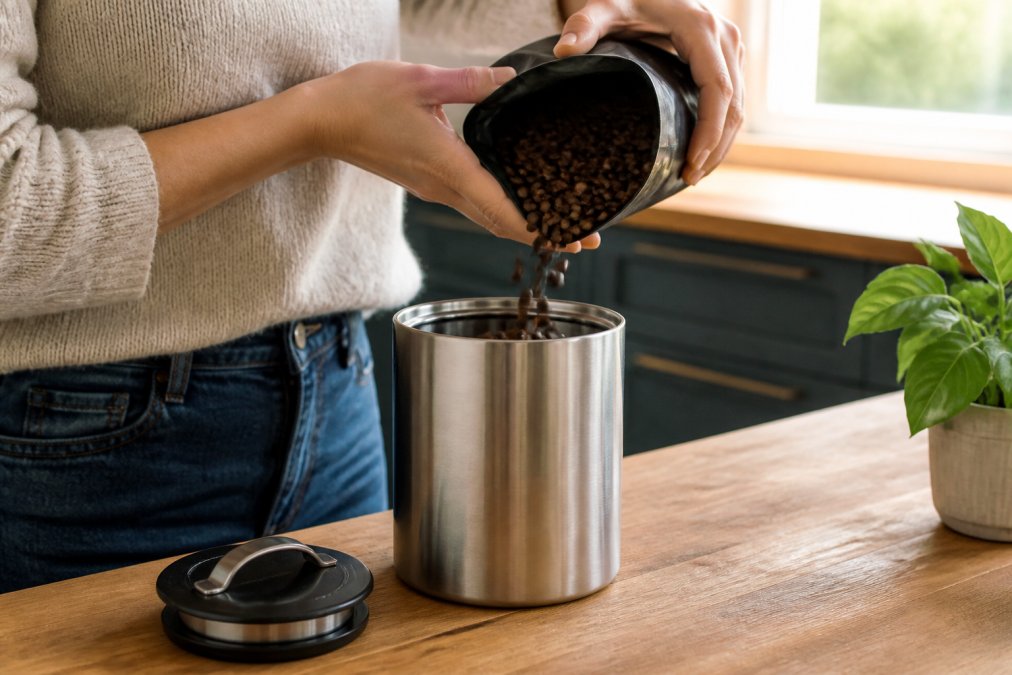
Glass jars look lovely but let light through, which breaks down coffee oils. Clear plastic is worse: it scratches and holds onto old odors.
What most guides miss is the seal. A beautiful canister with a loose lid is just a decorative bowl. Look for a silicone gasket or vacuum seal, and press the lid down to test resistance.
Container Material Science: What Actually Blocks Oxygen and Light
Most guides tell you to buy an "airtight container" and stop there. That advice is incomplete: the material determines how well it blocks UV light and oxygen. Here is how the common options compare.
Stainless steel is the strongest all-around choice: fully opaque, odor-resistant, and durable enough to outlast several plastic canisters. The trade-off is that you cannot see how much coffee is left without opening the lid, which exposes beans to fresh oxygen. Some stainless canisters include a one-way valve in the lid, solving the degassing problem without opening the container.
Dark ceramic blocks light almost as well as stainless, provided the glaze is opaque. It is heavier and can chip, and cheaper canisters sometimes have odor-retaining glazes, so look for a food-safe interior glaze and a silicone gasket. Ceramic also conducts heat more slowly than metal, a small advantage in a warm kitchen.
Glass is the most common mistake. Clear glass transmits most visible light and a meaningful share of UV, both of which accelerate oxidation of the oils on the bean surface; amber or dark-tinted glass reduces this but does not eliminate it.
Why Opaque, Airtight Containers Beat Clear Jars
Opaque blocks UV light. Airtight blocks oxygen. Clear jars do neither, no matter how tightly you screw the lid.
A quick way to judge any container:
- Hold it up to a window. If light passes through, it fails.
- Fill it with water and shake. If it leaks, air gets in too.
- Check the seal material. Silicone gaskets last longer than foam.
- Skip containers that need you to press out air by hand. They rarely seal well.
Climate Changes Which Container You Need
Most storage guides assume a mild, dry kitchen. In a humid or very dry climate, the rules shift.
Freezing Coffee Beans: When It Helps and When It Hurts
Freezing coffee beans works well for long-term storage, but only with whole beans and only if you seal them properly. Moisture is the danger. Every time you open a frozen bag, condensation forms on the cold beans.
How Roast Level Changes Your Freezing Strategy
Most freezing advice treats all coffee the same. It should not: light and dark roasts behave differently in the freezer, and the difference comes down to oil content and degassing rate.
How to Thaw Beans Without Condensation
Thaw sealed portions on the counter for a few hours before grinding. Leave the container closed the whole time. Opening it early lets warm air hit cold beans and form condensation, which is exactly what you are trying to avoid.
A Bulk Storage Workflow for 5-Pound Bags
If you buy coffee in large amounts, a 5-pound bag or a subscription that ships more than you can drink in two weeks, freezing is not optional. It is the only way to keep the back half of that order fresh. Here is a workflow home baristas commonly use.
Signs of Stale Coffee Beans (and How to Avoid Them)
Stale beans announce themselves in a few clear ways. Learn the signs and you will never waste a bag again.
- No aroma when you open the bag or grind
- A flat, papery, or cardboard-like smell
- Dull, matte surface instead of a slight oily sheen
- Beans that feel dry and light rather than dense
- A sour or bitter cup with no sweetness
- Weak crema in espresso
Climate, Roast Level, and Bulk Storage: Advanced Tips
Storage advice changes with your climate and your roast. This is where most guides stop short.
Common Coffee Storage Myths That Waste Your Beans
The real difference between good coffee and great coffee often comes down to how fast it gets to you. Artisan Bean roasts premium, micro-batch beans to order and ships directly to your door, so the coffee you taste is the coffee the roaster intended. Our fast fulfillment protects freshness from roast to first brew, and our direct farm partnerships mean every bag supports sustainable sourcing. Get started with Artisan Bean and turn your daily cup into a ritual worth savoring.
Frequently Asked Questions
How long do coffee beans stay fresh in a sealed bag?
Whole beans in an unopened, valve-sealed bag stay at peak freshness for about two to four weeks after the roast date. After opening, flavor fades within seven to ten days if the bag is not resealed properly. For the best way to store coffee beans, transfer them to an airtight, opaque container after opening, or squeeze the air out of the original bag and seal it tightly. Beans stored past their peak still work for brewing, but the aroma and complexity drop noticeably.
Is it better to store coffee beans in glass or stainless steel?
Stainless steel wins for most kitchens because it blocks all light, which accelerates staleness. Glass can work if it is opaque or kept in a dark cupboard, since clear glass lets UV light through and exposes coffee oils to damage. Whichever you choose, the container must be airtight. Among the best coffee storage canisters, look for a tight gasket seal and a capacity that matches how much you brew in one to two weeks.
Should you keep coffee beans in the fridge?
No. The fridge exposes beans to moisture, odors, and temperature swings every time the door opens. Coffee beans are porous and absorb nearby smells, so your beans can end up tasting like last night's leftovers. For daily use, keep beans in an airtight, opaque container in a cool, dark cupboard away from the stove. If you buy more than two weeks' worth, freezing coffee beans is a better option than refrigeration.
Does freezing coffee beans actually preserve their flavor?
Yes, when done correctly. Freezing slows oxidation and preserves volatile compounds that carry aroma. The key is to freeze beans in small, airtight portions so you never thaw more than you will use in a few days. Let frozen beans come to room temperature before grinding to prevent condensation from forming on the beans. Avoid repeatedly thawing and refreezing the same batch, since moisture buildup degrades bean integrity and dulls the flavor profile.