

Fresh Roasted vs Grocery Store Coffee: 2026 Comparison
Table of Contents
- Fresh Roasted vs Grocery Store Coffee: The Quick Comparison
- Coffee Roast Date vs Best By Date: What the Labels Actually Mean
- How to Tell If Coffee Beans Are Fresh: 5 Checks Anyone Can Do
- Why Fresh Roasted Coffee Tastes Different: Degassing, Oxidation, and Peak Flavor
- How to Store Coffee Beans for Maximum Freshness at Home
- Sourcing, Traceability, and Environmental Impact: What Grocery Shelves Hide
- How to Choose Fresh Roasted Coffee Without Overpaying
- Frequently Asked Questions
Last Updated: September 30, 2026
Fresh Roasted vs Grocery Store Coffee: The Quick Comparison
The difference between fresh roasted vs grocery store coffee comes down to one number: the roast date. Coffee hits peak flavor roughly 4 to 14 days after roasting, then fades. Grocery beans often sit for months before you open them.
| Factor | Fresh Roasted | Grocery Store |
|---|---|---|
| Typical roast-to-shelf time | Days | Weeks to months |
| Label you'll see | Roast date | Best by date |
| Flavor at opening | Vibrant, complex | Muted, flat |
| Cost per bag | Higher | Lower |
| Traceability | Farm and lot details | Rarely disclosed |
| Best for | Daily ritual drinkers | Backup and budget brewing |
Coffee Roast Date vs Best By Date: What the Labels Actually Mean
A roast date tells you when the beans left the roaster. A best by date tells you when the seller wants the bag gone from shelves. Only one of those is useful to you.
How to Tell If Coffee Beans Are Fresh: 5 Checks Anyone Can Do
You can judge freshness without any special equipment. Five quick checks will tell you more than any marketing claim on the bag.
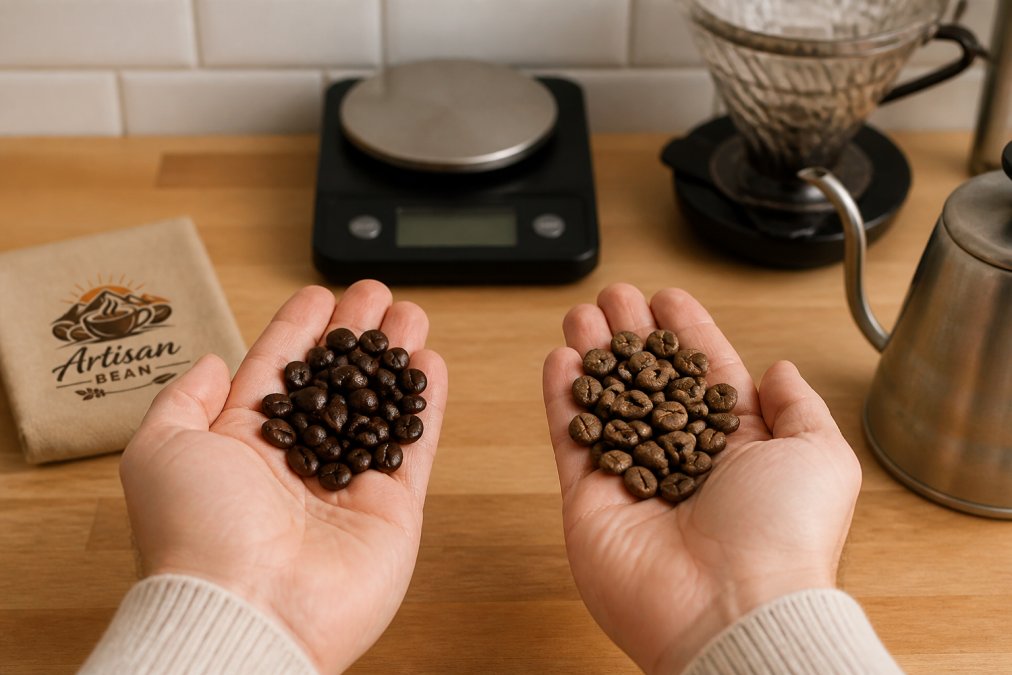
- Smell the bag. Fresh beans release a strong, sweet aroma the moment you open the seal. Flat or papery smells mean the coffee has faded.
- Squeeze a bean. Fresh roasted beans are dense and resist a hard pinch. Stale beans crush easily and feel light.
- Look at the surface. Fresh beans have a slight sheen from oils that migrate outward over the first few days. Dull, dry-looking beans have lost that.
- Grind a small batch. Fresh coffee grinds with a springy resistance and releases a burst of aroma. Stale beans grind flat and dusty.
- Brew and watch the bloom. Pour hot water over fresh grounds and the bed puffs up as carbon dioxide escapes. A weak or missing bloom is a clear freshness signal.
The Blind Taste Test: How to Compare at Home
Set up two cups with the same dose, same grind, and same water temperature. Have someone else label them A and B so you don't know which is which. Taste both, note aroma, acidity, sweetness, and finish, then reveal.
Why Fresh Roasted Coffee Tastes Different: Degassing, Oxidation, and Peak Flavor
Coffee flavor fades through two processes: degassing and oxidation. Roasting traps carbon dioxide inside the bean, and that gas escapes over the days after roasting, carrying aroma compounds with it. Oxygen then moves in and turns oils rancid.
How to Store Coffee Beans for Maximum Freshness at Home
Storage is where the fresh roasted vs grocery store coffee comparison actually gets decided. A fresh bag stored badly can fall to grocery-aisle quality within two weeks. A grocery bag stored well can hold its (already modest) flavor for a few weeks longer than its packaging suggests. The goal is the same in both cases: slow down degassing and block oxygen, light, heat, and moisture.
The storage setup that actually works
An opaque, airtight container kept at room temperature, away from the stove, the window, and the dishwasher, beats almost every gadget sold for the purpose. One-way valve bags work too, but only if you reseal them properly and press out excess air after each scoop.
What matters more than the container:
- Buy whole beans and grind right before brewing. Grinding multiplies surface area and accelerates staling by an order of magnitude.
- Keep the bag sealed and squeeze out excess air after every use.
- Skip the fridge. Condensation and food odors migrate into beans fast.
- Freeze only for long-term storage, in a sealed bag with the air pressed out, and thaw the full bag before opening to avoid condensation.
- Buy in amounts you'll finish within a few weeks.
Storing fresh roasted coffee vs grocery store coffee
The two bags need different handling because they start from different places.
A practical timeline
- Days 0-4 post-roast: Rest whole beans. Too much CO2 makes drip coffee taste sharp and espresso extract unevenly.
- Days 4-14: Peak flavor window for most roasts. This is when fresh coffee earns its price.
- Days 14-30: Flavor fades noticeably. Still good, but the brightness and layered sweetness are thinning.
- Days 30-60: Most drinkers can taste the drop. Acceptable in milk drinks, less so black.
- Beyond 60 days: This is grocery-aisle territory. Oxidation dominates and the cup reads flat and papery.
If you're coming from a bag that's been open on the counter for a month, expect the first properly stored fresh bag to taste almost shockingly different. The variable isn't just the roast date, it's what happened to the beans after you opened the bag.
Sourcing, Traceability, and Environmental Impact: What Grocery Shelves Hide
Grocery coffee is usually a blend of commodity beans from many farms, pooled together for consistency and low cost. That model makes it nearly impossible to trace a bag back to a single grower or region, and it also shapes the environmental footprint in ways the label never mentions.
Trip Around The World Coffee Club →
The supply chain footprint, step by step
Coffee's carbon footprint comes from four main stages: growing, processing, shipping, and roasting. How each stage is handled differs sharply between commodity grocery supply chains and direct-trade local roasting models.
What traceability actually proves
A farm name on a bag is the only real proof of origin. A vague "sustainable" or "responsibly sourced" label means little without a grower, region, or cooperative behind it. For buyers who care about labor practices and environmental methods, traceability is the entry point, not the marketing copy.
The honest trade-off
Direct-trade and local roasting usually cost more per bag, and the environmental case isn't absolute, a small roaster shipping a single bag across the country can have a higher per-bag footprint than a full truckload of grocery coffee moving efficiently to a regional distribution center. The clearer wins are in growing method, handling, and freshness, not in every mile of transport.
How to Choose Fresh Roasted Coffee Without Overpaying
You don't need to spend the most to drink well. You need a roaster who prints a roast date, ships soon after roasting, and lets you buy in amounts that match your pace.
Frequently Asked Questions
Does grocery store coffee go bad?
Yes. Coffee is a perishable product, and grocery store coffee is often weeks or months past its roast date by the time you buy it. Once roasted, beans begin losing carbon dioxide and volatile aroma compounds through a process called oxidation. Most grocery bags use a best by date rather than a roast date, which tells you nothing about when the coffee was actually roasted. If the bag feels soft, smells faint, or the beans look dry and dull, the coffee has already passed its peak flavor window.
What is the shelf life of fresh roasted coffee beans?
Whole bean coffee reaches peak flavor roughly 4 to 14 days after roasting, depending on the roast level and bean density. After about 4 to 6 weeks, most of the aromatics have faded noticeably. Ground coffee stales much faster because more surface area is exposed to oxygen, often within days. Storing beans in an airtight container away from light, heat, and moisture slows the decline but does not stop it. Buying smaller amounts more often beats stockpiling.
How can you tell if coffee beans are fresh without a roast date?
Look for a one-way valve on the bag, which lets carbon dioxide escape without letting oxygen in, and check whether the bag feels firm or slightly inflated from degassing. Fresh beans have a glossy surface and a strong aroma when you open the bag. They also feel denser and grind differently than stale beans, which tend to shatter unevenly. If the bag has no roast date and no valve, treat it as a sign the coffee was packaged for shelf life, not freshness.
Is expensive coffee actually better than grocery store coffee?
Price alone does not guarantee quality, but fresh roasted coffee from a micro-batch roaster usually costs more because it is roasted to order in small quantities rather than mass produced for long shelf life. The difference shows up in flavor profile: specialty coffee tends to have clearer acidity, more distinct aroma, and traceable single-origin character. Artisan Bean's Trip Around The World Coffee Club, for example, ships a freshly roasted 1lb bag from a different country each month for $25, with no shipping charges in the US.
How should I store coffee beans for maximum freshness?
Keep whole beans in an opaque, airtight container at room temperature, away from the stove, the fridge door, and direct sunlight. Do not transfer beans into the hopper of your grinder and leave them there for days. Buy in quantities you will finish within two to three weeks. If you buy more, freeze a portion in a sealed bag and let it come to room temperature before grinding. Grinding right before brewing makes the biggest single difference to how fresh the cup tastes.
The hardest part isn't finding fresh coffee. It's going back to the flat, muted cup once you've tasted what fresh roasting actually delivers. Artisan Bean roasts in small batches to order, partners directly with sustainable farms, and ships immediately after roasting so nothing sits on a shelf losing its character. Start with a sample pack or join the Coffee Club and see what your morning ritual has been missing.