

How to Tell if Coffee Beans Are Fresh
Table of Contents
- Why Freshness Matters for Your Coffee
- Check the Roast Date vs Expiration Date
- Perform the Coffee Bloom Test
- Assess Aroma and Visual Signs
- How to Store Coffee Beans Properly
- Understanding Coffee Shelf Life
- Frequently Asked Questions
Last Updated: September 25, 2026
Why Freshness Matters for Your Coffee
Fresh coffee smells vibrant and complex because the beans are still releasing carbon dioxide. Stale coffee has lost that aroma and tastes flat.
Coffee oxidizes from the moment it's roasted. The oils and aromatic compounds that create complexity break down and dissipate within weeks, leaving a hollow, papery cup.
How to tell if coffee beans are fresh is straightforward, freshness leaves clear, detectable signals.
Check the Roast Date vs Expiration Date
The roast date and expiration date are not the same thing.
The roast date is when the beans were roasted. Coffee peaks in flavor for two to four weeks after roasting; after that, flavor deteriorates noticeably.
The expiration date is misleading, roasters often set it six months to a year ahead to protect themselves legally, not your coffee quality.
When shopping:
- Always choose roast date over expiration date. No roast date is a red flag.
- Look for recent roast dates. Ideally within the last two weeks.
- Calculate the age. More than three weeks old means past peak flavor.
- Direct-to-consumer roasters ship fresher beans because they roast and ship immediately, eliminating warehouse time.
Perform the Coffee Bloom Test
The bloom test is a simple, free way to assess freshness by checking if beans are still actively degassing.
Roasting produces carbon dioxide trapped in the bean. Fresh beans retain this gas; stale beans have lost most of it.
To perform the bloom test:
- Grind a small amount of beans (about 15 grams or a tablespoon) into a medium consistency, similar to what you'd use for pour-over coffee.
- Pour hot water (around 200 degrees Fahrenheit) over the grounds in a cup or small bowl.
- Watch what happens in the first 30 seconds. Fresh beans will bubble and foam visibly. The CO2 escaping creates that bloom effect. Stale beans will sit flat with minimal bubbling.
- Note the intensity. A vigorous, sustained bloom lasting 30-45 seconds signals fresh beans. A weak, brief bloom or no bloom at all indicates staleness.
The bloom test works because it reveals what's actually happening inside the bean. Fresh beans are still degassing actively. Stale beans have already lost most of their gas. This test is especially useful if you're buying beans without a visible roast date.
Note: Use hot water for this test. Cold water won't trigger the bloom effect.
Assess Aroma and Visual Signs
Your senses are powerful tools for evaluating freshness, but many beginners mistake oily beans for stale ones or confuse complex aroma with flat, oxidized smells.
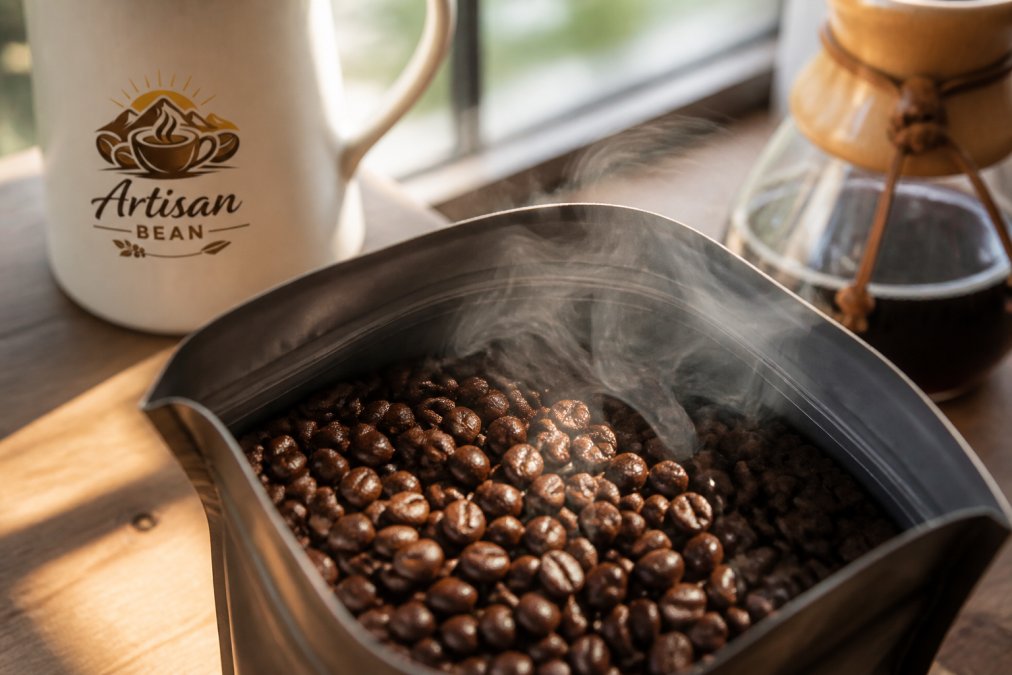
Aroma is the first and most reliable signal. Fresh beans smell strong and complex, chocolate, caramel, fruit, nuts, or spice. Stale coffee smells flat, papery, or musty. Weak or absent aroma means the beans have lost significant freshness.
Visual inspection reveals another layer, but it requires understanding what you're looking at. This is where many people go wrong.
Fresh bean oils vs. rancid oils: Fresh beans develop a glossy, wet-looking sheen within two weeks, a sign of life, not age. These oils contain flavor compounds. Rancid oils appear dull and sticky, smell off or sour, and indicate weeks of oxidation. Fresh oils shine and smell complex; rancid oils stick and smell flat.
Light roasts: These naturally have less visible oil because the roasting is shorter. Look for vibrant, consistent color and strong aroma instead. Lack of visible oil is normal, not a sign of staleness.
Trip Around The World Coffee Club →
What to look for in visual inspection:
- Color consistency: Even tone; blotchy color indicates age or uneven roasting.
- Surface appearance: Glossy sheen = fresh oils; dull or chalky = oxidation.
- Vibrancy: Fresh beans catch light; stale beans appear lifeless.
- Texture: Beans should feel dense; stale beans feel lighter or powdery.
- Damage: Cracks, splits, or mold are red flags.
The combination test: Strong, complex aroma + vibrant color + appropriate oiliness (for the roast level) = fresh beans. If any of these three elements is missing or weak, the beans are past their peak. If all three are absent, the beans are significantly stale and should be avoided.
How to Store Coffee Beans Properly
Proper storage slows oxidation and preserves aroma and oils, but it cannot reverse staleness.
Coffee's enemies are air, light, heat, and moisture, each accelerates flavor degradation.
Airtight containers are essential. Oxygen causes oxidation, which breaks down the aromatic compounds and oils that give coffee its complexity. Use a container that seals tightly. One-way degassing valves, which allow CO2 to escape without letting air back in, are ideal. Many specialty roasters use bags with these valves built in, they're the small one-way flaps you see on coffee bags. These valves are crucial because they let the beans continue to degas (releasing CO2) without allowing oxygen to enter. A flat bag without a valve is actually a sign that either the beans are old (they've already degassed) or they're stored improperly.
Keep beans away from light. UV light accelerates oxidation. Store your beans in a dark place, or in an opaque container. Clear glass jars look nice, but they're not ideal for long-term storage. If you use a clear container, keep it in a cupboard or drawer away from direct sunlight.
Temperature matters. Room temperature (around 65-75°F) is fine for short-term storage (a few weeks). Avoid placing beans near heat sources like ovens, radiators, or direct sunlight. Warmth accelerates oxidation and can cause oils to break down faster.
The freezing debate, what actually works: This is where most storage advice goes wrong. Many sources claim freezing preserves coffee freshness indefinitely. This is partially true, but with critical caveats that most people ignore.
Freezing does slow oxidation dramatically. At freezer temperatures, chemical reactions that cause staleness happen much more slowly. If done correctly, frozen beans can maintain reasonable freshness for several months longer than room-temperature storage.
However, freezing introduces a new problem: moisture. Every time you remove beans from the freezer and open the container, warm air enters and condensation forms on the cold beans. This moisture accelerates oxidation when the beans warm up.
The correct freezing method:
- Divide beans into small portions before freezing. Use vacuum-sealed bags or airtight containers that hold only what you'll use in 1-2 weeks.
- Freeze immediately after purchase in an airtight, moisture-proof container (vacuum-sealed bags work best).
- Thaw completely before opening. Remove the container from the freezer and let it reach room temperature before opening. This prevents condensation from forming on the beans.
- Use the thawed portion immediately. Don't return partially used beans to the freezer. The repeated temperature cycling causes condensation and accelerates oxidation.
- Keep the rest frozen. The portions you're not using should stay in the freezer until you're ready to thaw another batch.
Here's a practical storage strategy:
- For beans you'll use within 2-3 weeks: Store in an airtight container in a cool, dark cupboard. This is the ideal scenario.
- For beans you'll use within 1-2 months: Store in an airtight container in a cool, dark cupboard, or freeze in small portions using the method above.
- For long-term storage (2-3+ months): Freeze in vacuum-sealed bags in small portions, thaw completely before opening, and use immediately.
- The best approach overall: Buy smaller quantities more frequently rather than stockpiling. Fresh beans used within two weeks will always taste better than perfectly stored beans used after two months.
Understanding Coffee Shelf Life
Coffee shelf life is often misunderstood. A bag of coffee doesn't go bad like milk does. It doesn't become unsafe to drink. It just becomes less enjoyable.
| Storage Condition | Peak Flavor | Acceptable Range | Declining Quality |
|---|---|---|---|
| Cool, dark, airtight | 2-4 weeks | 4-12 weeks | 3-6 months |
| Room temp, sealed bag | 2-3 weeks | 3-8 weeks | 2-4 months |
| Exposed to light/air | 1-2 weeks | 2-4 weeks | 1-2 months |
Frequently Asked Questions
How does the bloom test work for coffee freshness?
The coffee bloom test involves pouring hot water over ground coffee and watching for vigorous bubbling. Fresh beans release carbon dioxide (CO2) during degassing, creating a visible bloom within seconds. Stale beans produce little to no bloom because they've already lost most of their CO2. This visual cue is one of the most reliable indicators that your beans are fresh and will produce a vibrant, flavorful cup.
What is the difference between roast date and expiration date?
The roast date tells you when the beans were actually roasted, while an expiration date is often a generic estimate. The roast date is far more important because coffee begins losing flavor immediately after roasting due to oxidation and CO2 loss. Beans roasted within the past two weeks are at peak flavor. Many commercial coffees hide their roast date or list one that's months old, which is why checking the roast date is essential for confirming freshness.
How long will coffee beans remain fresh?
Coffee beans are at their best within two to four weeks of the roast date. After two weeks, they're still good but begin losing complexity and vibrant notes. By four weeks, oxidation and CO2 degassing have noticeably dulled the flavor profile. Beyond six to eight weeks, beans taste noticeably stale, hollow, or papery. Proper storage in an airtight container extends this window slightly, but the roast date is always the true measure of freshness.
Does the smell of coffee beans indicate freshness?
Yes, aroma is a powerful freshness indicator. Fresh beans have a fragrant, vibrant smell that's complex and inviting. Stale beans smell flat, muted, or sometimes rancid. If you open a bag and notice a faint or dull aroma, the beans have likely lost their peak flavor. Trust your nose: a strong, pleasant scent signals that the beans are fresh and will deliver the flavor profile the roaster intended.