

Ethical Sourcing in Specialty Coffee: A 2026 Guide
Table of Contents
- What Ethical Sourcing in Specialty Coffee Actually Means
- Coffee Farmer Wages and the Living Income Gap
- Coffee Certifications: What They Verify and What They Don't
- Direct Trade Coffee: Strengths and Blind Spots
- Coffee Supply Chain Transparency: How to Verify Ethical Claims
- Smallholder Farmers, Power Imbalances, and Climate Resilience
- How to Choose Ethically Sourced Coffee: A Buyer's Framework
- Frequently Asked Questions
Last Updated: October 21, 2026
What Ethical Sourcing in Specialty Coffee Actually Means
Ethical sourcing in specialty coffee means buying beans under terms that protect the people who grow them, the land, and the supply chain's long-term viability. It combines fair compensation, safe working conditions, environmental stewardship, and traceable farm-to-cup relationships.
Most coffee drinkers assume "specialty" implies ethical. It doesn't. Specialty grading measures cup quality and defect counts, not how a picker was paid or whether a farm's water source was protected.
Beyond the Label: The Five Pillars of Ethical Coffee
We group ethical sourcing into five pillars, because a bag that scores well on one often fails on another:
- Fair prices paid above the commodity benchmark, negotiated with the producer rather than set for them
- Worker rights and fair wages, including safe conditions and protection for seasonal labor
- Environmental protection, covering soil health, water conservation, biodiversity, and deforestation
A roaster that can speak to four of these five is doing real work. One that speaks only to the first is running a marketing program.
Coffee Farmer Wages and the Living Income Gap
The central problem in ethical sourcing is not that farmers are paid nothing, but that they are often paid too little to stay in farming. Farm-gate prices, what a producer receives before export, milling, and shipping, frequently fall below the true cost of production once labor, inputs, and land are counted. Closing that gap is the hardest lever to verify from a bag.
What a Living Income Benchmark Actually Measures
Living income benchmarks are regional estimates of what a household needs for food, housing, healthcare, school fees, and a modest buffer, derived from household expenditure surveys and local price data and published per household, not per kilogram of coffee.
In many smallholder regions, coffee income covers only part of household needs, with the rest from subsistence crops, livestock, or off-farm labor. Programs focused solely on coffee price can miss the families most at risk.
Farm-Gate Prices vs. Production Costs
When a buyer negotiates on farm-gate price alone, the producer absorbs every cost increase, fertilizer, scarce labor, and the farmer's margin disappears first.
Production costs typically include hired labor for picking and processing, inputs like fertilizer and seedlings, equipment maintenance, and the opportunity cost of family labor.
Ask a roaster how they set prices. A published benchmark plus a quality premium is a good sign; "market rate" tells you the farmer absorbed the difference.
Why Price Floors Alone Don't Close the Gap
Fair trade minimum prices and cooperative social premiums are important tools, but they are floors, not living incomes. Where production costs are high or households are large, a price floor can still fall short of a living income benchmark, which is why some programs now publish living income reference prices alongside farm-gate prices.
For buyers, ask two questions: what price was paid, and what would a living income look like for that household? A roaster who can answer both is engaging with the economics, not the marketing.
Coffee Certifications: What They Verify and What They Don't
Coffee certifications are third-party audit programs that verify specific practices against a published standard. They are useful but narrow: each checks a defined list of criteria and says nothing about the rest.
That is not a flaw so much as a scope limit. The ISEAL Code of Good Practice sets out how credible sustainability standards should be designed, which is a useful benchmark for judging any scheme.
Fair Trade, Organic, Rainforest Alliance, and Bird Friendly Compared
| Certification | What It Verifies | What It Misses | Best For |
|---|---|---|---|
| Fair Trade | Minimum price floor, social premium, cooperative governance | Environmental practice, individual farm traceability | Buyers prioritizing producer price stability |
| Organic | Prohibited inputs, soil and pest management, annual inspection | Labor conditions, price paid to farmer | Buyers prioritizing chemical-free cultivation |
| Rainforest Alliance | Ecosystem protection, worker conditions, farm management | Guaranteed minimum price | Buyers wanting combined social and environmental checks |
| Bird Friendly | Shade-grown habitat requirements, canopy structure | Price and labor criteria | Buyers focused on biodiversity and migratory bird habitat |
None of these seals covers living income directly. None guarantees a long-term relationship. Use them as one input, not the whole picture.
Direct Trade Coffee: Strengths and Blind Spots
Direct trade coffee is a sourcing model where a roaster buys straight from a producer or cooperative, bypassing importers and exporters. The strength: fewer hands between farm and roaster, more room for real conversation about price and quality.
The blind spot is equally obvious.
Documentation separates the two. Roasters doing it well name the farm, state the price relationship, and maintain contact across multiple harvests. Those using it as shorthand usually can't answer a follow-up question.
Coffee Supply Chain Transparency: How to Verify Ethical Claims
Coffee supply chain transparency is the degree to which a buyer can trace a bag to a specific producer and confirm the transaction terms. Verification is the hard part, and where most ethical claims go untested.
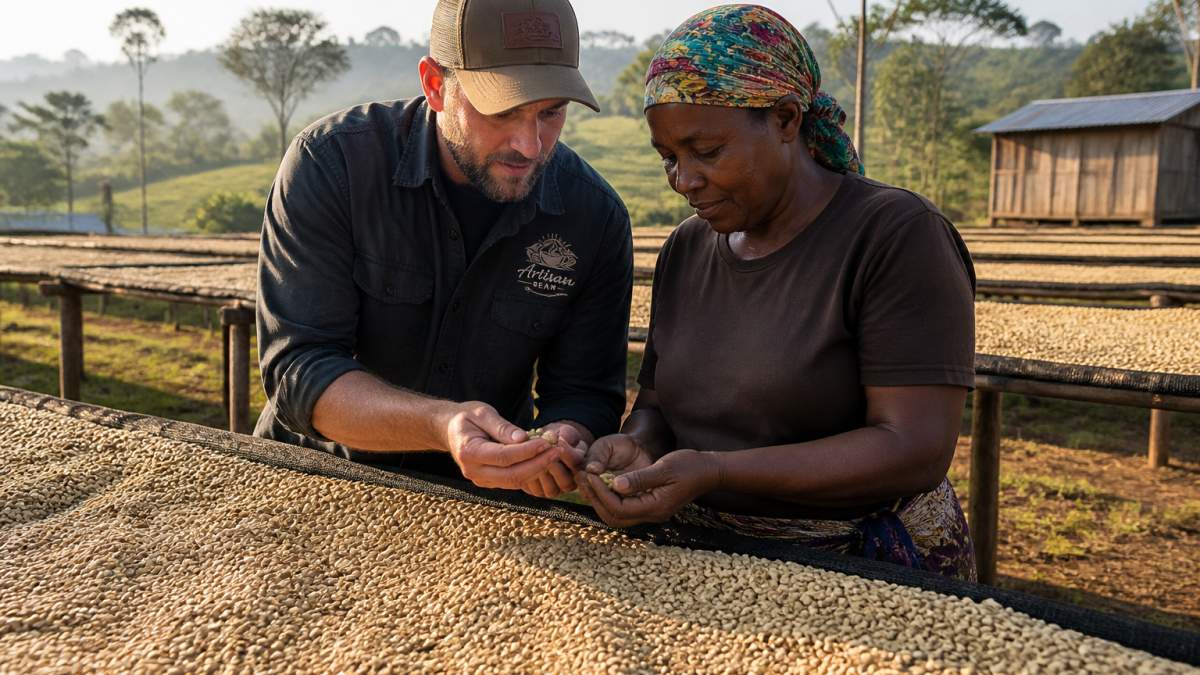
The Three Verification Mechanisms
Documentation and chain-of-custody records. A buyer should be able to produce contracts, invoices, and price records showing what was paid and to whom.
Third-party audits. An independent body inspects against a published standard, as described in Fairtrade International's standards. The ISEAL Code of Good Practice sets out how credible sustainability standards should be designed, which is a useful benchmark for judging any scheme.
Direct relationship and farm-level knowledge. The roaster has stood on the farm and can describe conditions from memory, not a brochure.
Most roasters can supply one of the three. The strongest programs supply all three, and publish enough of it that a customer can check.
The Limits of Certification Claims
Certifications verify process against a defined standard, not outcomes. Fair Trade confirms a minimum price was paid and a social premium administered, but not that the household reached a living income.
Treat a single seal as one input among several; the most informative claims are those a roaster publishes voluntarily, farm name, price paid, harvest year, relationship length, because a buyer can actually check those.
Questions to Ask a Roaster Before You Buy
This checklist works whether you're emailing a roaster or reading a product page:
- Can you name the farm, cooperative, or region for this specific lot?
- What price was paid to the producer, and how was it set?
- Which certifications apply, and were they verified for this harvest?
A roaster who answers four or more with specifics is worth your money. One who answers none with "we care deeply about sustainability" may not be dishonest, but gives you nothing to verify.
Smallholder Farmers, Power Imbalances, and Climate Resilience
Most of the world's coffee is grown by smallholders, many on plots under a few hectares.
Climate resilience is the second half of the same problem. Coffee is sensitive to temperature shifts, irregular rainfall, and disease, and smallholders have the least capital to adapt.
This is why ethical sourcing and climate adaptation are not separate causes. Guidance from the Food and Agriculture Organization on sustainable coffee production makes the same connection between producer livelihoods and long-term supply security.
How to Choose Ethically Sourced Coffee: A Buyer's Framework
Choosing ethically sourced coffee means matching your priorities to verifiable evidence, not labels. Use this framework, scored out of five, to compare any bag:
- Traceability (0-2 points): Farm or cooperative named, region specified, and price paid disclosed.
- Certification (0-1 point): A credible third-party seal that matches your priority, whether that's price floor, organic practice, or habitat.
- Relationship (0-1 point): Evidence of multi-harvest partnership or documented producer visits.
- Freshness and quality (0-1 point): A roast date you can read, and a flavor profile that justifies the price.
Score four or higher and you are buying from a program with real substance. Two or below and you are paying for a story.
At Artisan Bean, we source from named smallholder groups, including the Kintamani farmers behind our Bali Blue, grown on volcanic loam at 1,200 to 1,600 meters and hand-picked, wet-hulled, and dried on raised beds. Our Ethiopia Natural comes from smallholders in the Sidama zone, and our Colombia from smallholders around Medellín.


If you want to taste the difference across origins before committing to a full bag, the Single Origin Favorites Sample Pack includes six 2-ounce packs for $27.99.
The hardest part of ethical sourcing is not finding a bag with a seal.
At Artisan Bean, we roast in small batches to order and ship right after roasting, so the coffee you taste is the coffee the roaster intended.
Frequently Asked Questions
What does ethically sourced coffee mean?
Ethically sourced coffee means the beans were produced and traded with fair treatment of everyone involved, from farmer to roaster. In practice, that covers fair prices above production costs, safe working conditions, respect for worker rights, and environmental care such as soil health and water conservation. It also means transparency: buyers can trace where the coffee came from and how it was traded. Ethical sourcing is a process of continuous improvement, not a single label. A roaster that publishes farm names, prices, and audit results is giving you more to work with than one that simply prints 'sustainable' on the bag.
How can you tell if coffee is ethically sourced?
Start with traceability. Look for a named region, cooperative, or farm, not just a country. Check whether the roaster publishes sourcing standards, audit results, or a transparency report. Certifications such as Fair Trade or Rainforest Alliance provide third-party verification, but they are a starting point rather than proof of everything. Ask the roaster directly: what price did the farm receive, and how does it compare to production costs? Vague answers about 'long-term relationships' without specifics are a warning sign. Coffee supply chain transparency is the most reliable signal you can check as a consumer.
Do certifications guarantee that coffee is ethically sourced?
No. Coffee certifications verify specific standards, such as minimum prices, organic farming methods, or habitat protection, but each covers a narrow slice of ethical sourcing. A Fair Trade label confirms a price floor and cooperative structure, not necessarily a living income for every farmer. Organic covers farming inputs, not labor conditions. Audits also happen periodically, so gaps can exist between inspections. Use certifications as one input alongside direct questions to the roaster, published sourcing reports, and evidence of long-term partnerships. A certified coffee from a roaster that also publishes farm-level details is a stronger choice than a label alone.
What is the difference between direct trade coffee and fair trade coffee?
Fair trade is a certification with third-party audits, published standards, and a price floor set by the certifying body. Direct trade coffee is a relationship model where roasters buy straight from producers, often at prices above commodity rates, without a single governing certification. Direct trade can mean closer communication, faster feedback on quality, and premiums that reach the farm. It can also be less accountable, because no external body verifies the claims. The strongest direct trade programs publish prices and visit farms regularly. Ask a roaster what verification backs its direct trade claims before treating the term as a guarantee.
How are coffee farmer wages determined for ethically sourced coffee?
Most coffee farmers are paid per unit of green coffee sold, not a wage in the salaried sense. The farm-gate price depends on the commodity market, quality premiums, and the buyer's negotiating position. Ethical sourcing programs aim to pay above production costs and toward a living income, which is the amount a household needs for decent housing, food, healthcare, and schooling. Certification price floors help, but they are not always equal to a living income. Transparency about the actual price paid, compared with local production cost benchmarks, is the clearest way to judge whether coffee farmer wages are genuinely fair.
How can coffee roasters improve supply-chain transparency?
Roasters can publish farm names, regions, and the prices paid, ideally compared with local production costs. Annual sourcing reports, farm visit notes, and named relationships with cooperatives give buyers something verifiable. Third-party audits and certification records add external checks. Roasters can also shorten the chain by buying directly from exporters or producer groups and by sharing quality feedback with farmers, which builds long-term partnerships. The goal is a supply chain a customer can follow from farm to cup. Even small roasters can start with a simple page listing origins, partners, and the standards they apply.
What questions should coffee buyers ask their suppliers?
Ask where the coffee was grown, down to the region or cooperative, and who the producer is. Ask what price the farm received and how it compares with production costs in that area. Ask which certifications apply and what they verify. Ask how the roaster verifies working conditions and environmental practices, and whether audits or farm visits happen. Ask about the length of the relationship and how quality feedback reaches the farmer. Finally, ask what the roaster does when a supplier falls short. Specific, documented answers signal real ethical sourcing; vague assurances do not.