

Trade Coffee vs French Press: Which Is Right for You
Table of Contents
- Understanding the Comparison: Trade Coffee vs Press Coffee
- How Coffee Subscriptions Work vs Manual Brewing
- Freshness and Roast Date: A Critical Difference
- Flavor Profile and Body: What You'll Actually Taste
- French Press Grind Size and Brewing Fundamentals
- How to Brew Coffee with a French Press: Step-by-Step
- Cost Comparison: Subscription Pricing vs One-Time Purchases
- Convenience, Customization, and Commitment
- Frequently Asked Questions
Last Updated: October 16, 2026
Understanding the Comparison: Trade Coffee vs Press Coffee
When you're deciding between trade coffee vs press coffee, you're really choosing between two different philosophies. One prioritizes freshness and convenience through direct roasting and delivery. The other puts control and ritual into your hands. At Artisan Bean, we've spent years helping coffee enthusiasts understand that this isn't an either-or decision, it's about matching your brewing method to how you want to experience coffee.
The comparison between trade coffee and press coffee gets at something fundamental: how much do you care about freshness, and how much do you value hands-on control? A coffee subscription delivers beans roasted to order and shipped immediately, eliminating the staleness that plagues grocery store coffee. A French press, meanwhile, gives you complete command over water temperature, steep time, and grind size.
How Coffee Subscriptions Work vs Manual Brewing
The Subscription Model: Roasted to Order and Delivered
A coffee subscription service roasts beans after you place an order, then ships them within days. This model eliminates the months-long journey from roaster to warehouse to retail shelf that drains coffee of its complexity.
The subscription approach removes guesswork from sourcing. You receive beans matched to your taste preferences, often from direct trade relationships with coffee farmers. The roaster handles all decisions about origin selection, roast level, and grind options.
Subscription services also solve the freshness problem that haunts traditional retail. Grocery store coffee sits in warehouses and on shelves for weeks or months before you brew it. By the time you open the bag, the vibrant aromatics have faded significantly. A subscription model compresses that timeline dramatically.
Manual Brewing: Control and Customization
Brewing with a French press puts you in charge of every variable. You choose the beans, the grind size, the water temperature, the steep time. This level of control appeals to people who enjoy the ritual and want to dial in their perfect cup.
Manual brewing also means you can experiment. Change the water temperature by five degrees and taste the difference. Adjust your steep time and notice how it affects body and extraction. This hands-on approach transforms coffee from a commodity into a craft. For home baristas, this is often the draw.
The trade-off is responsibility. You need to understand grind sizes, water quality, and brewing technique. You're also responsible for sourcing good beans yourself. Many people find this rewarding. Others find it overwhelming.
Freshness and Roast Date: A Critical Difference
The roast date is where coffee subscriptions and manual brewing intersect most importantly. Coffee begins to fade within days of roasting. After two weeks, the volatile aromatics that define complexity have diminished noticeably.
When you buy coffee from a grocery store, the roast date on the bag is often 4-8 weeks old. By the time you brew it, it may be 2-3 months past roasting.
A coffee subscription solves this by design. Beans ship within days of roasting, arriving at peak freshness.
If you're buying whole beans for French press brewing, freshness matters just as much. Sourcing from a roaster that publishes roast dates and ships quickly gives you the same advantage as a subscription model.
Flavor Profile and Body: What You'll Actually Taste
Coffee flavor changes dramatically based on freshness and brewing method. A subscription service roasting to order preserves the complexity that the farmer and roaster worked to create. You taste the origin characteristics, the fruit notes, the acidity, the finish, because they haven't oxidized away.
A French press extracts those flavors differently than other brewing methods. The immersion brewing process, where grounds steep in hot water, pulls more oils into the cup. This creates body and mouthfeel that drip or filtered coffee can't match.
The flavor you experience depends on three things working together: bean freshness, grind size, and brewing technique. Fresh beans from a subscription give you the raw material. A properly ground French press grind and correct water temperature unlock the full potential.
French Press Grind Size and Brewing Fundamentals
Grind Size Requirements for French Press
A French press requires a coarse grind, larger than drip coffee, much larger than espresso. The reason is immersion time. Coarse grounds steep for 4 minutes without over-extracting. Fine grounds would turn bitter within that timeframe because the larger surface area pulls too much from the bean.
Coarse grind looks like breadcrumbs or sea salt. If your grind is too fine, you'll taste bitterness and get sediment throughout the cup. Too coarse, and the coffee tastes weak and thin. This is where control becomes important. A burr grinder lets you dial in the exact size. A blade grinder produces inconsistent particles and makes French press brewing frustrating.
Water Temperature and Brew Time
Water temperature for French press should be between 195-205 degrees Fahrenheit. Boiling water (212 degrees) over-extracts quickly. Too-cool water under-extracts. Most people simply let boiled water cool for 30 seconds before pouring, this brings it into the ideal range without needing a thermometer.
Steep time is typically 4 minutes for a standard French press. Some people prefer 3 minutes for lighter extracts, others go 5 minutes for fuller body. The variables interact: hotter water extracts faster, so you might shorten time. Cooler water extracts slower, so you might extend it. This is the experimentation that makes manual brewing engaging.
How to Brew Coffee with a French Press: Step-by-Step
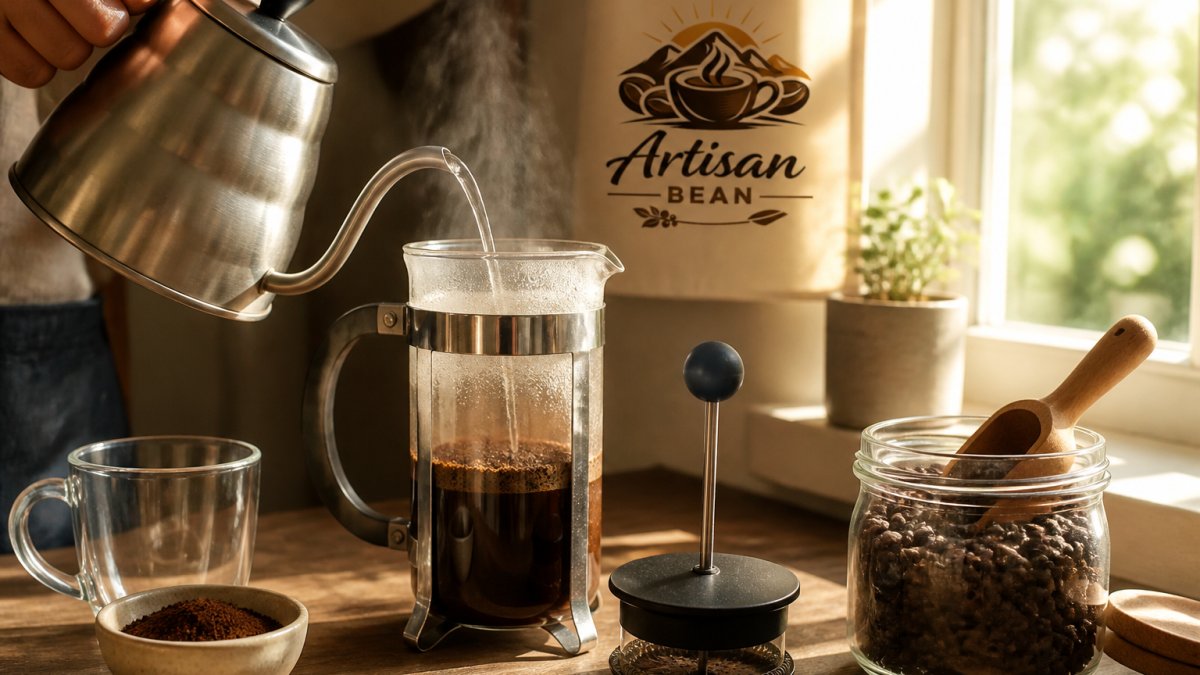
Preparation and Measurement
Start with a clean French press. Rinse it with hot water to remove any residue from the previous brew. Use a ratio of 1 gram of coffee to 16 grams of water as your baseline. For a standard 34-ounce French press, that's roughly 2 tablespoons of coarsely ground coffee to 8 ounces of water. Adjust this ratio based on how strong you like your coffee.
Grind your beans immediately before brewing. Coffee begins losing volatile aromatics within minutes of grinding. Fresh-roasted beans from a subscription service are ideal here because you're maximizing their peak window. Add the grounds to the bottom of the press and pour just enough hot water to saturate them. Wait 30 seconds, this bloom allows CO2 to escape and improves extraction.
Steeping and Extraction
Pour the remaining hot water slowly into the press. Fill it to about an inch below the top. Set a timer for 4 minutes. While the coffee steeps, the immersion process pulls flavor, body, and oils from the grounds. You'll see the bloom settle and the water darken.
After 4 minutes, gently break the crust that forms on the surface with a spoon. Skim off any foam or floating grounds. Let the press sit for another minute, which allows fine particles to settle to the bottom. This prevents sediment in your cup.
Press the plunger down slowly over 20-30 seconds. Pressing too quickly can spray hot water and grounds. The metal filter traps most particles, but some fine sediment will remain, that's normal with French press brewing. Pour immediately into your cup.
Common French Press Mistakes to Avoid
The biggest mistake is using a fine grind. This leads to over-extraction, bitterness, and a cup full of sediment. French press needs coarse grind. Period.
The second mistake is leaving coffee in the press after brewing. Even a few extra minutes of contact with grounds changes the flavor. Pour immediately after pressing.
Third is using water that's too hot or too cool. If your water just boiled, wait 30 seconds. If it's cooled more than a minute, reheat it. Temperature consistency matters.
Cost Comparison: Subscription Pricing vs One-Time Purchases
Artisan Bean's offerings range from the Breakfast Blend at 22.99 to the Medium Blend at 24.99. A single bag makes roughly 15-20 cups depending on your brew ratio.

One-time purchases at specialty roasters run similar prices per bag. Grocery store coffee costs less upfront, often 8-12 dollars per bag, but that lower price reflects the staleness problem. You're paying for convenience, not freshness.
The real cost comparison isn't per pound, it's per cup. A 24.99 bag of fresh-roasted subscription coffee that delivers 18 excellent cups works out to about 1.39 per cup. But you're not comparing equivalent experiences.
Subscription services also eliminate waste. You order what you'll drink. There's no half-full bag of stale coffee sitting in your pantry.
Convenience, Customization, and Commitment
A coffee subscription handles sourcing for you. You receive beans matched to your taste profile, roasted fresh, delivered to your door. No decisions, no trips to the store.
The customization question splits two ways. A subscription service lets you customize frequency (weekly, bi-weekly, monthly) and sometimes roast level or origin preference. But you're ultimately choosing from what the roaster offers.
Commitment varies by service. Most subscriptions let you pause or cancel anytime. Some offer discounts for longer commitments.
| Aspect | Subscription Coffee | French Press Brewing |
|---|---|---|
| Freshness | Roasted to order, peak flavor guaranteed | Dependent on sourcing quality and timing |
| Control | Limited to roaster's offerings | Complete control over every variable |
| Convenience | Automatic delivery, no sourcing needed | Requires research and sourcing |
| Customization | Frequency and preferences | Grind, temperature, time, bean selection |
| Commitment | Flexible, cancel anytime | None, buy as needed |
| Cost per Cup | 1.39 to 1.75 dollars | 0.67 to 1.50 dollars depending on source |
| Ritual Value | Minimal, coffee arrives ready | High, hands-on brewing experience |
| Time Investment | Low, just brew | Medium to high, sourcing and technique |
The real insight is that these aren't competing choices. Many coffee enthusiasts subscribe to fresh-roasted beans specifically to brew with a French press. The subscription solves the freshness problem. The French press provides the control and ritual.
If you're serious about your daily cup but tired of the staleness that plagues grocery store coffee, a subscription service solves the sourcing problem while a French press gives you the control to maximize every brew. Artisan Bean delivers fresh-roasted beans designed for manual brewing methods, with our Medium Blend offering balanced body and acidity perfect for immersion brewing, and our Breakfast Blend bringing smooth South American notes that shine through in a French press. Join Our Coffee Club and experience the difference that freshness and technique make together.

Frequently Asked Questions
Can you use Trade Coffee beans in a French press?
Yes. Coffee sourced from a subscription service works perfectly in a French press as long as you use the correct grind size. Fresh beans from a coffee roaster, when ground coarse for immersion brewing, deliver the full body and sediment that French press brewing is known for. The key is requesting a coarse grind or grinding whole beans yourself just before brewing to preserve the flavor.
What grind size should I use for French press coffee?
Use a coarse grind for French press brewing, similar to breadcrumbs or sea salt. Fine grounds over-extract and create sediment and bitterness, while coarse grounds allow proper steeping without over-extraction. A consistent coarse grind ensures even extraction and the rich body that makes French press coffee distinctive. If you buy whole beans, invest in a burr grinder to achieve uniform particle size.
Is a French press cheaper than a coffee subscription?
The French press method itself costs less upfront and lasts years. However, the ongoing bean cost depends on where you source them. A coffee subscription delivers fresher beans roasted to order. Over time, subscription services often provide better value because you're paying for freshness and quality, not shelf-life compromises.
Does coffee from a subscription taste stronger than French press coffee brewed with grocery store beans?
Fresh-roasted subscription coffee will taste noticeably more vibrant and complex than stale grocery-store beans, regardless of brewing method. French press brewing itself produces a fuller body and richer mouthfeel than drip coffee because it steeps grounds in hot water and retains coffee oils. The combination of fresh beans plus French press immersion brewing creates the strongest, most flavorful cup. Stale beans brewed in a French press will still taste flat compared to fresh beans.