

Manual Grinders for Beginners vs Electric: What to Know
Last Updated: November 3, 2026
Quick Summary
Manual grinders win on price and grind consistency at the low end, while electric grinders win on speed and convenience. Under $200, a hand grinder often produces better grind quality at the same price, but above $300 a good electric grinder becomes worth considering for speed.
- CoffeeGeek lists the Kingrinder P2 at $45 and the Mavo Phantox Pro at $130.
- Hand grinding takes roughly 30 seconds of cranking, while electric grinding is instant.
- The best manual grinder for beginners has steel burrs and at least 15 clickable grind settings.
- One or two doses per day favors manual; three or more favors electric.
- Upgrade when your grinder cannot hold a setting or you move into espresso.
Table of Contents
- Manual Coffee Grinder vs Electric: The Core Trade-Off
- What Makes the Best Manual Coffee Grinder for Beginners
- Beginner Setup Costs: Manual vs Electric Side by Side
- Best Manual Coffee Grinder for Pour Over
- Best Manual Coffee Grinder for Espresso
- Ownership, Maintenance, and When to Upgrade
- Pair Your Grinder With Freshly Roasted Beans
- Frequently Asked Questions
Manual Coffee Grinder vs Electric: The Core Trade-Off
The best manual grinders for beginners compared to electric models come down to one trade: you spend effort instead of money, and you get better grind quality per dollar. At Artisan Bean, we watch home baristas make this choice every week, and the answer usually depends on how much you value five minutes of quiet, hands-on work each morning.
Here is the short version. Manual grinders win on price and grind consistency at the low end. Electric grinders win on speed and convenience. Everything else is detail.
CoffeeGeek's budget grinder guide lists the Kingrinder P2 at $45 and the Mavo Phantox Pro at $130, which shows how wide the manual price band runs. Meanwhile, Serious Eats' 2026 grinder review notes the Baratza Virtuoso+ carries over 40 grind settings, a feature count that usually costs more in the electric world.
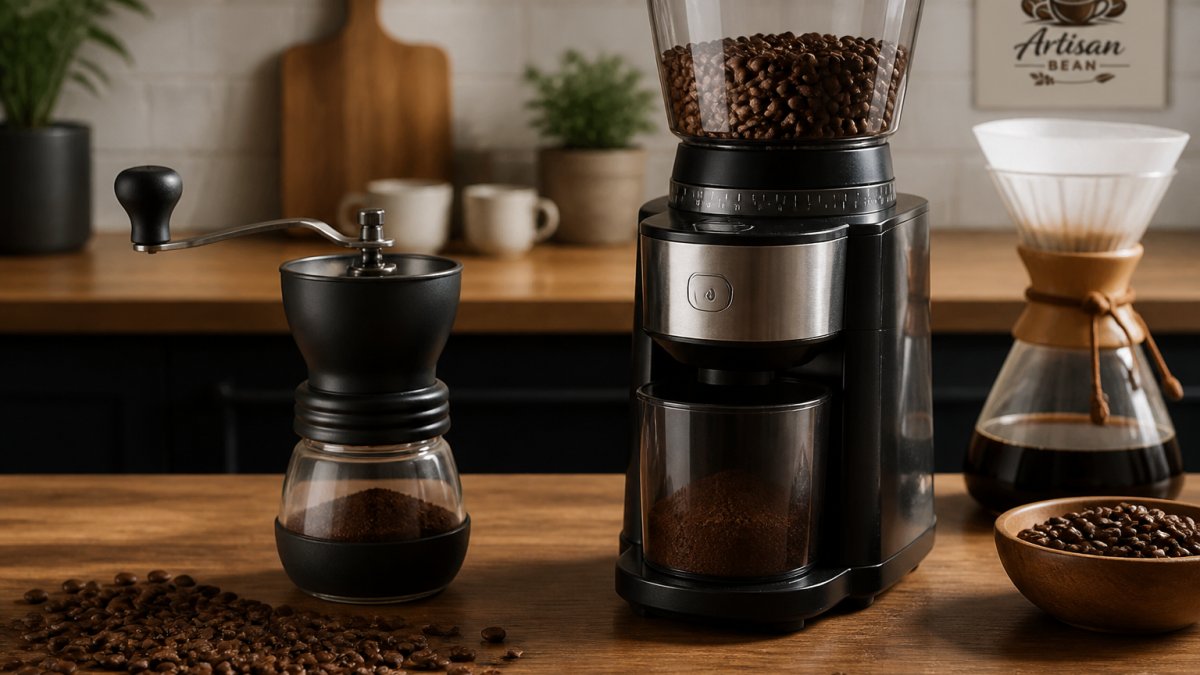
Grind Quality and Particle Uniformity
Grind quality is the evenness of the particles a grinder produces, and even particles extract at the same rate. That is why burr geometry matters more than motor size.
A common mistake is assuming electric always means better. Under $200, a hand grinder often produces better grind quality at the same price, according to Time for Espresso's comparison. Above $300, a good electric grinder becomes worth considering for speed.
If you want to understand what your grinder should be producing, our guide to coffee grind sizes for better home brewing breaks down what each brewer needs.
Speed, Effort, and Noise
Hand grinding takes roughly 30 seconds of cranking, while electric grinding delivers instant power, per French Press & Co's buying guide. Neither figure comes with a stated test method, so treat them as rough.
The real difference is noise. A manual grinder is nearly silent, which matters in a small flat at 6am. An electric burr grinder hums loud enough to wake a sleeping partner.
What Makes the Best Manual Coffee Grinder for Beginners
The best manual coffee grinder for beginners is one with steel burrs, a clear adjustment range, and a comfortable crank. Skip anything with ceramic burrs or vague settings.
Here is our checklist for judging a first hand grinder:
- Steel conical or flat burrs, not ceramic
- At least 15 clickable grind settings
- A crank handle that turns without wobble
- A catch cup that seals to the body
- Replacement parts available from the maker
- Weight and grip that suit your hand
The Way to Coffee 2026 guide names the Timemore C2 as its budget pick and the 1Zpresso J as its overall pick, which gives you two reference points at different prices.
Watch out: buying a grinder with a stepped adjustment you cannot fine-tune will leave you stuck between settings for espresso. Check the adjustment range before you buy.
Beginner Setup Costs: Manual vs Electric Side by Side
A beginner setup with a manual grinder costs less up front than an electric one, and the gap is widest at the entry level. But the useful comparison is not the sticker price alone. It is the realistic first-year cost of getting a grind you are happy with, including accessories and likely upgrades.
| Factor | Manual Grinder | Electric Grinder |
|---|---|---|
| Entry price | $45-$130 for capable hand grinders (CoffeeGeek, 2026) | Typically higher for comparable grind quality |
| Grind quality per dollar | Strong under $200 | Stronger above $300 |
| Speed per dose | About 30-60 seconds of cranking | Under 10 seconds |
| Noise | Near silent | Noticeable motor hum |
| Portability | Fits in a bag | Stays on the counter |
| Maintenance | Brush and occasional burr clean | Brush, plus motor care |
| Repair path | Replaceable burrs and handles | Motor or gear service |
| Likely first upgrade | A better hand grinder if you move to espresso | A better electric grinder if you outgrow entry models |
The table is a starting point, not a verdict.
A beginner decision framework helps more than a price list. Ask four questions in order. First, what is your brew method? Pour over and French press are forgiving, so a mid-range hand grinder is often enough. Espresso is demanding, so fine adjustment quality matters more than speed. Second, how many doses do you grind per day? One or two favors manual; three or more favors electric. Third, what is your budget for the grinder alone? Under $200, a hand grinder usually gives better grind quality per dollar. Above $300, a good electric grinder becomes worth considering for speed. Fourth, how much do you value quiet and portability? If either is high, manual has a clear edge.
Total first-year cost is where the two paths diverge in less obvious ways. A manual setup may need a brush, a spare catch cup, and eventually replacement burrs or a crank handle. An electric setup may need the same cleaning tools plus motor or gear service if something fails, and it may need counter space you would rather use for something else.
Best Manual Coffee Grinder for Pour Over
The best manual coffee grinder for pour over is a mid-range hand grinder with a wide adjustment range and consistent medium-fine output. Pour over rewards even particles because uneven beds channel water and sour the cup.
Look for a grinder that holds its setting across a full bag of beans.
If you are still deciding on a brewer, our comparison of pour over vs French press explains the clarity and body difference. Once you have settled on pour over, our guide to which single origin coffee is best for pour over helps you pick beans that suit the method.
Best Manual Coffee Grinder for Espresso
The best manual coffee grinder for espresso is one with fine, repeatable micro-adjustment, because espresso lives or dies on tiny grind changes. A grinder that jumps in big steps will fight you on every shot.
Espresso also demands more effort. Fine grinding takes longer to crank, and light roasts are harder work than dark ones. Expect a workout with dense beans.
Ownership, Maintenance, and When to Upgrade
Ownership costs for a manual grinder are low: a brush, occasional burr cleaning, and replacement parts if the maker stocks them. Electric grinders add motor and gear service to the bill.
Upgrade when your grinder cannot hold a setting, when you move into espresso, or when cranking a full dose stops being enjoyable. Our guide to storing coffee beans covers how to keep what your grinder produces tasting fresh.
Pair Your Grinder With Freshly Roasted Beans
That is the problem we built Artisan Bean to solve. Start with our Italian Roast for a dark roast option to grind with your new manual grinder. We roast in small batches, on order, and ship right after roasting.
Frequently Asked Questions
Are hand grinders better than electric grinders?
It depends on your budget and priorities. Manual grinders give you more control and portability for less money; electric grinders win on convenience and daily speed. For beginners, a quality manual grinder is often the smarter first purchase.
Is a manual coffee grinder good for beginners?
Yes, if you pick one with a wide adjustment range and clear grind settings. The best manual coffee grinder for beginners offers consistent burrs, comfortable cranking, and easy cleaning. Manual grinders are lower-cost and quieter than electric models, and hand grinding takes roughly 30 seconds per dose according to comparison guides. The main trade-off is physical effort, which matters if you grind large doses daily.
Do manual and electric grinders produce different grind quality?
Grind quality depends more on burr type and alignment than on whether the grinder is manual or electric. A well-built manual grinder with quality burrs can match or beat a budget electric model on particle uniformity. The difference shows up at price extremes: cheap electric grinders often produce uneven grinds, while a mid-range hand grinder delivers consistent results. Above $300, electric grinders close the quality gap and add speed.
Are manual grinders suitable for espresso?
Yes, but they need fine, repeatable adjustment. The best manual coffee grinder for espresso offers stepless or micro-step settings so you can dial in a 25-30 second shot. Hand grinding for espresso takes more effort than for pour over because the beans are ground finer. Models like the 1Zpresso range are positioned for precision work, while budget picks like the Timemore C2 suit filter brewing better.
Choosing a grinder is the easy part. Keeping it fed with coffee worth grinding is where most home setups fall down, and stale supermarket beans will flatten even the best manual grinder. Artisan Bean roasts micro-batch beans to order and ships them straight after roasting, with direct farm partnerships and fast fulfillment so your ritual never runs dry. Get started with Artisan Bean and taste what fresh-roasted coffee does for your morning cup.
