

7 Ways Climate Change Affects Coffee Bean Quality
Last Updated: October 30, 2026
Quick Summary
Yes, climate change affects coffee bean quality. Heat and water stress speed up cherry ripening, producing less dense beans with flatter acidity, muted sweetness and aroma, and thinner body. Severity depends on elevation, cultivar, and post-harvest handling.
- Warming is expected to shrink suitable coffee-growing land by 2050.
- Arabica is the quality-sensitive species most exposed to heat stress.
- Shade trees cool soil and buffer temperature swings during dry spells.
- Climate stress often flattens acidity and increases batch-to-batch inconsistency.
- Check roast date and named origin detail when choosing beans.
Table of Contents
- How Climate Change Alters Coffee Bean Quality
- Climate Change Effects on Coffee Quality: Heat, Rain and Ripening
- Coffee-Growing Regions at Risk from Climate Change
- Shade-Grown Coffee and Climate Resilience
- Climate-Smart Coffee Farming Practices
- What Changed Flavour Means in Your Cup
- Choosing Beans That Protect the Cup You Love
- Frequently Asked Questions
How Climate Change Alters Coffee Bean Quality
Does climate change affect coffee bean quality? Yes, and the evidence is piling up. A systematic review on climate change and coffee production found that warming is expected to cut worldwide coffee yields and shrink the land suitable for growing coffee by 2050. It also flagged real effects on bean quality. At Artisan Bean, we roast micro-batch beans to order, so we watch these shifts closely.
Here's the part most guides skip: quality isn't a side issue. It's the story.
Below, we'll show you exactly how heat, rain, and ripening changes reach your morning brew, and what you can do about it.
Climate Change Effects on Coffee Quality: Heat, Rain and Ripening
Climate change effects on coffee quality start inside the bean. A coffee plant builds its sugars and acids as the fruit ripens. Heat and water stress scramble that process.
Rising Temperatures and Heat Stress
Coffee has a narrow comfort zone. Push average air temperature too high and the plant hits heat stress. Cherries ripen too fast, often before they develop full flavor.
A 2026 Climate Central report on coffee-harming heat notes that suboptimal conditions can harm both the quality and quantity of the harvest. That means less coffee and a flatter cup.
Unpredictable Rainfall and Water Stress
Rain matters as much as heat. Irregular rainfall and drought cause water stress at the worst moments. Flowering gets thrown off, and beans fill out unevenly.
Research on Ethiopian Arabica and climate change ties rising temperatures, shifting rainfall, and extreme weather to real pressure on the crop. Fewer good beans per plant is the result.
Coffee-Growing Regions at Risk from Climate Change
Coffee-growing regions at risk from climate change sit mostly in the tropics, in a band called the Coffee Belt. But "at risk" doesn't mean the same thing everywhere. The quality impact depends on species, cultivar, elevation, and local microclimate, and that variation is where most coverage gets vague.
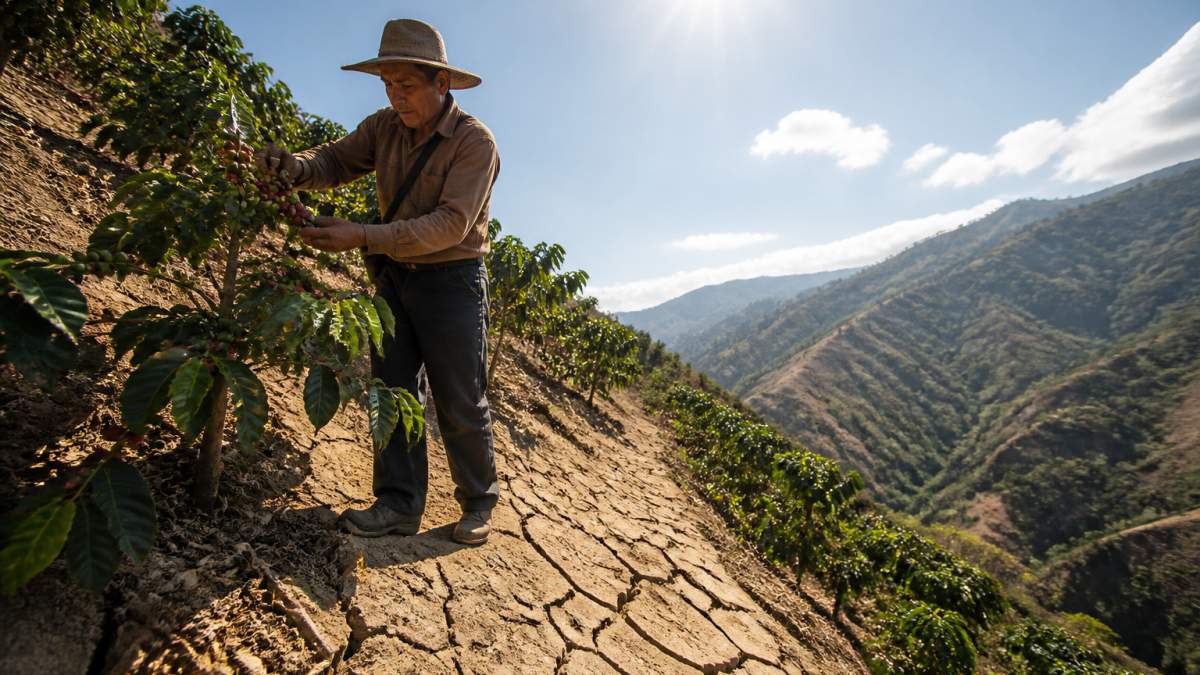
Arabica vs. Robusta: different beans, different exposure
Arabica is the quality-sensitive species. It evolved in cool, high-elevation Ethiopian forests and wants mild temperatures, steady rainfall, and altitude, roughly the conditions warming most directly threatens. Its narrow comfort zone is why Arabica is the bean most exposed to heat stress and why quality declines tend to show up there first.
Robusta is hardier. It tolerates higher temperatures and more variable rainfall, and it's generally grown at lower elevations.
Why elevation and microclimate change the outcome
Two farms at the same latitude can see very different quality outcomes. Elevation is the biggest lever, higher, cooler sites buffer heat stress and slow ripening in a way that protects density and acidity. A farm near its upper elevation limit may actually benefit from mild warming, while a farm already at the warm edge of Arabica's range has little room to adapt. Local microclimate, slope, aspect, shade cover, soil water-holding capacity, can offset or amplify regional trends. This is why blanket claims that "coffee quality is declining" miss the point: the direction and size of the effect is site-specific.
Cultivar differences matter too
Not all Arabica is equally vulnerable. Traditional landraces and some improved cultivars differ in heat tolerance, disease resistance, and how their quality holds up under stress. Breeders are actively developing cultivars that tolerate heat and disease, though there's often a trade-off between resilience and cup quality that the industry is still working through. A resilient cultivar that cups flat isn't a full solution.
Regional snapshots: Brazil, Ethiopia and beyond
Brazil and Ethiopia show how varied the risk is. A 2024 study on Brazilian coffee phenology projects shifts in flowering timing across Brazil's growing areas, which can desynchronize ripening and complicate harvest timing, a quality issue as much as a yield one. Ethiopia, Arabica's birthplace, faces its own heat and rain pressures across a wide range of elevations, so outcomes there are especially uneven. Other origins, Colombia, Kenya, Indonesia, Central America, each sit at different points on the exposure curve depending on elevation and microclimate.
Want to taste how origin shapes a cup? Explore our Ethiopia Natural single origin.

Shade-Grown Coffee and Climate Resilience
Shade-grown coffee and climate resilience go hand in hand. Trees overhead cool the soil and buffer temperature swings. They also slow water loss during dry spells.
A review on climate change and coffee quality points to light exposure, altitude, water stress, and temperature as key quality factors. Shade management lets farmers nudge several of these at once.
Agroforestry isn't a cure. Curious how sourcing ties in? Read our guide to ethical sourcing in specialty coffee.
Climate-Smart Coffee Farming Practices
Climate-smart coffee farming practices help farmers adapt without giving up quality. The best ones work with the plant, not against it.
- Plant climate-resilient varieties. Breeders are developing cultivars that tolerate heat and disease.
- Move uphill where possible. Higher elevation stays cooler, though land is limited.
- Manage shade and soil. Ground cover holds moisture and nutrients.
- Watch pests and plant diseases. Warmer conditions help both spread.
No single fix solves everything. Farmers combine tactics, and results vary by farm.
What Changed Flavour Means in Your Cup
Most coverage stops at "yields fall and quality suffers." That's not useful if you're trying to understand what actually changes in the cup. The honest answer is that climate stress doesn't produce one uniform flavor shift, it reshapes several sensory attributes in different directions depending on how the bean developed.
The mechanism: from stress to bean to brew
The chain runs like this. Temperature and water availability control how fast the cherry ripens and how evenly the bean inside fills out. When heat pushes maturation faster than the plant can supply sugars and organic acids, the bean ends up less dense, with a different chemical profile. Density matters because denser beans typically roast more evenly and hold more of the aromatic precursors that become sweetness and acidity in the cup. A common pattern in the research is that faster, hotter ripening correlates with lower bean density and less developed flavor precursors, though the size of the effect varies a lot by farm and season.
What that looks like attribute by attribute
- Acidity. Often the first thing to shift. In many stressed harvests, acidity becomes flatter and less structured rather than simply "lower." Citric and malic brightness can give way to a muddier, less defined cup. Some high-elevation lots may retain vivid acidity longer, which is why origin matters.
- Sweetness. Rushed ripening tends to reduce the accumulation of sugars that read as caramel, honey, or fruit sweetness. The cup can taste dry or hollow rather than sweet.
- Aroma. Aromatic complexity, florals, ripe fruit, spice, depends on a full, slow maturation. Compressed ripening often mutes these top notes.
- Body. Lower-density beans frequently translate to a thinner mouthfeel. The syrupy weight of a great natural process can become watery.
- Consistency. This is the underrated one. Climate variability means more uneven ripening within a single harvest, so a lot that once cupped cleanly may show more defects, more quakers, and more batch-to-batch variation. Roasters notice this as inconsistency rather than a single flavor flaw.
Why processing and storage can preserve or worsen it
Quality isn't locked in at the cherry. Drying and fermentation interact with climate-stressed harvests in ways that can help or hurt. Fruit picked under heat stress and rushed to the drying bed can ferment unevenly; careful washed processing and controlled drying can partly rescue a difficult lot, while sloppy natural processing can amplify the flat, fermented, or potato-like defects that show up more often in stressed seasons. Storage matters too, green coffee held in hot, humid conditions loses the very aromatics that were already under pressure. Our Bali Blue is roasted to order and shipped right after roasting, with dark chocolate and molasses notes.

Evidence quality: measured vs. projected
It's worth separating what's been measured from what's projected. Studies consistently find that heat and water stress affect bean development and cup quality in controlled and observed settings, but projections about future quality decline carry real uncertainty and vary widely by region. Not every farm or harvest is declining, some are holding steady or improving through adaptation. Treat claims of a uniform global quality collapse with skepticism; the more accurate picture is uneven, region-specific pressure.
Choosing Beans That Protect the Cup You Love
You can't control the weather. You can control what you buy. Choose beans from farms that you can verify are sourced responsibly.
| What to Check | Why It Matters | Where to Look |
|---|---|---|
| Roast date | Freshness preserves flavor | Bag, not just "best by" |
| Origin detail | Region signals climate risk | Farm or zone named |
| Processing method | Affects cup clarity | Washed, natural, etc. |
| Sourcing claims | Backs ethical farming | Verifiable partners |
Our guide on how to identify ethically sourced coffee beans walks through how to evaluate sourcing claims. Ready to shop? See our sustainably sourced coffee beans online. And if you love fruit-forward cups, our roundup of coffee bean origins for fruit notes is worth a read.
Frequently Asked Questions
Does climate change affect the taste and quality of coffee beans?
Yes. A 2022 systematic review in PubMed Central reports that climate variability causes changes in the quality and preservation of coffee products, and NOAA's climate-and-coffee explainer lists loss of quality among the effects of warming. A 2021 review led by S. Ahmed identifies light exposure, altitude, water stress, temperature, carbon dioxide and nutrient management as factors that shape coffee bean quality. The research describes clear risk to cup quality, though it does not give one single global number for how much quality has dropped.
Which coffee-growing regions are most vulnerable to climate change?
The Coffee Belt, the band of tropical highlands where coffee grows, faces the sharpest exposure. A 2025 study on Ethiopian Arabica reports that rising temperatures, changing rainfall patterns and extreme weather affect the crop. A 2024 study projects climate-related changes in coffee phenology, including anthesis, in Brazil's growing areas. The 2022 systematic review projects a reduction in worldwide coffee-suitable land by 2050. Vulnerability depends on elevation, water access and farm management, so risk is not uniform across regions.
Can shade-grown coffee help protect bean quality?
Shade-grown coffee and agroforestry are among the adaptation approaches discussed in climate research. The 2021 systematic review summary identifies light exposure, temperature and water stress as factors that shape coffee bean quality, and shade trees can moderate temperature and light at the plant level. The supplied research does not quantify how much shade protects quality, so treat it as a risk-reduction practice rather than a guarantee. It also supports biodiversity and farm resilience alongside quality.
How does changing rainfall affect coffee bean development?
Coffee plants need predictable rain for flowering, bean development and maturation. The research summary on Ethiopian Arabica names changing rainfall patterns as a climate impact, and the 2021 review lists water stress among the factors that influence coffee quality. Drought and irregular rainfall can interrupt bean development and lead to smaller beans, while extreme weather adds further risk. Post-harvest processing and storage are also identified as climate-vulnerable, so quality risk continues after picking.
Climate change is reshaping coffee bean quality, and the cup in your hand is where you'll feel it first. At Artisan Bean, we fight back with freshness: micro-batch roasting to order, direct partnerships with sustainable farms, and fast shipping right after the roast. Join our Coffee Club and taste what fresh-roasted, thoughtfully sourced coffee can do for your daily ritual.
